

When We Talk About AI, We Don’t Talk About AI
AI has become one of those words that means different things to different people. For some, it sounds expensive, technical, and slightly threatening. Other’s know we have been using AI for decades. Whether to correct your grammar or figure out which user is going to be most receptive to our advertising.
So when companies come to MBD asking about AI integration for business, we don’t usually start by talking about AI at all.
We talk about automation.
Because automation isn’t dramatic. It isn’t futuristic. It isn’t philosophical. It’s practical. It’s about reducing friction inside systems that already exist. And most businesses don’t need artificial intelligence as much as they need their operations to make more sense.
The hype cycle wants AI to feel revolutionary. In reality, the most valuable integrations are evolutionary.
AI Integration Strategy Is Really an Automation Strategy
When you strip away the language, AI integration for business is simply the discipline of improving how work moves through your organization.
Most companies we work with already have the core infrastructure in place. They have a CRM. They have marketing platforms. They have SaaS tools managing operations, communication, banking, and reporting. They may even have small automations layered in over time.
Oftentimes, the problem is misalignment.
Data doesn’t flow cleanly. Workflows were built around past constraints. Manual steps were added as temporary fixes and never removed. One person can create a bottleneck that slows the entire team. Over time, the system becomes dependent on people remembering how it works instead of the system working how it was designed.
That’s where automation comes in.
Before we ever discuss models or machine learning, we evaluate how information flows across your CRM and SaaS stack, where tasks are repeating unnecessarily, and where there are opportunities to improve the customer experience.
Why We Start With Your CRM
Your CRM is not just a database. It is a reflection of how your business thinks about relationships.
It contains the business patterns that idenitfy your brand. How leads move, how follow-ups happen, how long decisions take, where communication stalls. If those patterns are inconsistent or unclear, introducing AI will only accelerate confusion.
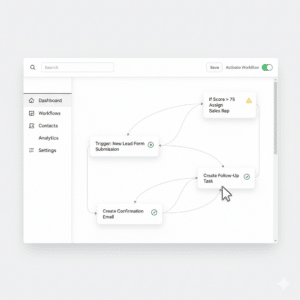
Our AI integration process almost always begins with CRM automation and workflow alignment. We examine how leads are scored, how tasks are triggered, how handoffs occur between departments, and how customer service requests are routed.
Once the system is structured properly, intelligent automation becomes simple. Lead prioritization improves. Follow-ups become consistent. Internal visibility increases. Not because the AI is impressive, but because the structure underneath it makes sense.
The tool is never the hero. The design is.
Automation Should Reduce Weight, Not Add Complexity
There’s a misconception that AI integration should feel transformative. In practice, the best implementations feel subtle.
Repetitive tasks disappear quietly. Reports generate themselves. Status updates don’t require reminders. Data flows without manual correction. Teams stop spending energy on logistics and start spending energy on judgment.
When automation is working properly, no one says, “This feels like artificial intelligence.” They say, “This feels easier.”
That ease is the real return on investment.
AI workflow automation is not about replacing people. It is about protecting their attention. The cognitive load required to keep a business running decreases. Decisions become cleaner because the data supporting them is consistent.
The Human Voice Still Matters
There is one boundary we do not cross.
Just because something can be automated does not mean it should be.
We integrate automation into CRM systems, marketing workflows, and sometimes call center environments. But we do so with strict attention to brand voice and customer experience. Automation that ignores tone or context erodes trust quickly.
Technology is excellent at repetition, categorization, and pattern recognition. It is not excellent at empathy, nuance, or judgment. When those lines blur, customer experience suffers.
That’s why human-centered automation is a core part of our approach. AI supports communication; it does not erode the need for it. It accelerates follow-through but does not replace accountability.
In an environment where AI is increasingly common, authenticity becomes even more valuable.
Discovery Is More Important Than Deployment
The most important phase of any AI integration for business is not implementation. It is discovery.
Before a single automation is built, we map how the business currently operates. We identify opportunities and pinpoint where roadblocks originate. We assess the cost of inefficiencies and model the impact of resolving them. We prioritize use cases based on stability, return, and risk.
AI amplifies whatever system it touches. If the system is fragmented, fragmentation accelerates. If the system is aligned, alignment scales.
That’s why we approach automation as a discipline rather than a feature.
What AI Integration Looks Like When It’s Working
When AI is integrated responsibly, the business does not feel futuristic. It feels stable.
Teams trust the CRM because it reflects reality. Workflows require fewer manual interactions. Customer responses are faster but still feel personal. Leadership has clearer visibility into performance without requesting constant updates.
When we talk about AI at MBD, we don’t talk about AI.
We talk about designing systems that work and then allowing intelligence to amplify them.