

One of the more interesting projects we’ve worked on recently started with what seemed like a simple question.
Could Meta advertising generate profitable signups at a cost of around $25 per acquisition?
I was confident we could get there. Like most performance campaigns, I explained that success wouldn’t come from guessing. We’d need to test creative, validate tracking, optimize the customer journey, and let the data show us where improvements needed to happen.
That’s exactly what we did.
Initial results were promising. The offer was compelling, people were signing up, and even while we were still refining the technical foundation, it was obvious there was momentum.
Then the real work began.
Good Marketing Starts With Good Data
As we optimized the campaign, we uncovered several technical issues that prevented us from making informed decisions.
A Google Tag Manager configuration needed to be corrected. A checkout update disrupted conversion tracking. Another tagging issue surfaced shortly afterward.
None of those problems stopped people from signing up, but they limited our ability to understand which marketing efforts were actually producing results.
Once the tracking infrastructure was stabilized, we shifted our attention to conversion optimization.
That’s when everything started clicking.
The campaigns began producing new customers for roughly $5 per acquisition, significantly outperforming the original target.
On paper, it looked like a huge success.
Then we received the phone call that changed the conversation.
What Customer Retention Strategy Really Means
The issue wasn’t campaign performance.
The issue was retention.
Customers were joining the program, but many weren’t staying beyond the introductory period.
Technically, we had accomplished exactly what we were hired to do. We generated qualified signups well below the target acquisition cost.
But the business wasn’t actually measuring success by signups.
They were measuring success by long-term customers.
That’s an important distinction because a customer retention strategy doesn’t begin after someone becomes a customer. It begins with attracting the right customer in the first place.
Marketing can generate attention.
Marketing can generate clicks.
Marketing can generate purchases.
But if the people entering the business aren’t the people most likely to succeed, marketing eventually gets blamed for a problem it can’t solve alone.
Customer Acquisition and Customer Retention Are Different Strategies
This project reminded me that customer acquisition and customer retention are related, but they’re not the same objective.
Customer acquisition asks:
“How do we get more people through the door?”
Customer retention asks:
“How do we attract the people who are most likely to stay?”
Those questions require different data.
Once retention became the primary metric, the next marketing move became obvious.
Instead of optimizing campaigns around trial conversions, we wanted to build lookalike audiences based on the company’s best long-term customers, the people who received the most value and stayed the longest.
That’s where performance marketing becomes dramatically more effective.
Not when you optimize for the cheapest customer.
When you optimize for the right customer.
Unfortunately, we never received the retention data needed to build those audiences.
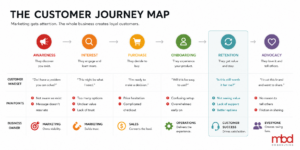
Customer Journey Mapping Reveals Where You Lose Customers
One of the reasons we spend so much time building customer journey maps is because they expose where businesses actually begin losing customers.
Marketing creates awareness.
Sales helps convert interest into a purchase.
Operations delivers the product or service.
Customer Success creates retention.
Leadership connects the systems that allow every department to work together.
If any one of those handoffs breaks, the customer experiences the disconnect.
In this project, marketing successfully moved customers through awareness, consideration, and purchase. The friction didn’t appear until after onboarding, when retention became the business’s real measure of success.
That’s why customer journey mapping is one of the most valuable exercises a growing business can complete.
It shifts the conversation away from:
“How do we generate more leads?”
and toward:
“Why aren’t customers staying?”
Those are two very different business problems.
Marketing Can’t Build Customer Retention Alone
One lesson has become more obvious with every client we’ve worked with.
Marketing doesn’t operate in isolation.
Customer Support understands why people leave.
Sales hears objections before anyone else.
Operations understands fulfillment and delivery.
IT manages the systems connecting the customer experience.
Marketing depends on all of them.
Without feedback from those departments, campaigns eventually optimize around the wrong metric because they lack the context needed to improve customer quality.
That’s why we often say:
Marketing takes everyone.
Not because everyone needs to run campaigns.
Because every department contributes to customer retention.
The strongest customer retention strategies aren’t built by marketing teams alone.
They’re built by organizations that share information across the entire customer journey.
The Best Customer Retention Strategy Starts Before the Sale
Looking back, I don’t consider this project a marketing failure.
The campaigns performed exactly as they should have.
The lesson was simply larger than advertising.
A customer retention strategy isn’t about convincing more people to stay.
It’s about creating a business that consistently attracts the right customers, delivers on its promises, and gives those customers a reason to continue the relationship.
Marketing plays an important role in that process.
So do operations.
So does customer support.
So does leadership.
Sustainable growth happens when everyone is working toward the same definition of success.
Because marketing can get customers through the door.
But the business determines whether they want to stay.